Research & Publications
My work sits at the intersection of physics and computation — atomistic simulation to understand the structure and mechanics of advanced materials, and numerical modelling of low-dimensional quantum systems.
Research Interests
Two lines of work run in parallel. The first is the computational study of bulk metallic glass (BMG) systems — currently Cu–Zr–Ag alloys, Vitreloy 1, and polycrystalline deformation mechanics — combining classical molecular dynamics (MD) with ab initio molecular dynamics (AIMD) and machine-learned interatomic potentials trained on first-principles data. The second is low-dimensional semiconductor systems: quantum wells and barriers, quantum wires, quantum rings and quantum dots. For quantum wells, an in-house finite-element solver covers external-field effects and the optical response that follows from them; finite-difference solvers in one and two dimensions, first applied to asymmetric triple wells, are being extended to wires, rings and dots.
Tools & Methods
Electronic structure & AIMD — Quantum ESPRESSO (plane-wave DFT and AIMD, PAW/PBE), CP2K (Gaussian/plane-wave AIMD), OLCAO (all-electron LCAO for bond order, densities of states, effective charges)
Machine-learned potentials — MLIP-3 (moment tensor potentials), pacemaker (atomic cluster expansion), potfit (force-matched EAM), with active learning to extend the training set
Classical MD — LAMMPS, cross-validated across independent potentials rather than relying on a single fit
Analysis — OVITO, freud, ASE, Atomsk; Python and Fortran
In-house — a P1 finite-element solver in Fortran (LAPACK/BLAS) for confined states in quantum wells, and one- and two-dimensional finite-difference Schrödinger solvers in Python for coupled-well structures
Computing — SLURM-based national and European HPC systems: TRUBA (Turkey) and MareNostrum 5 at the Barcelona Supercomputing Center, through a EuroHPC allocation
Publications & Presentations
Journal Articles
B. Hunca, C. Dharmawardhana, R. Sakidja, and W.-Y. Ching, “Ab initio calculations of thermomechanical properties and electronic structure of vitreloy Zr41.2Ti13.8Cu12.5Ni10Be22.5,” Physical Review B 94, 144207 (2016). DOI: 10.1103/PhysRevB.94.144207
Conference Proceedings
B. Hunca, C. Dharmawardhana, and W.-Y. Ching, “Electronic structure and bonding in vitreloy (Zr41.2Ti13.8Cu12.5Ni10Be22.5),” PNCS-XIV.
Conference Presentations
“Structures and Raman spectra of molten MCl3 systems,” international conference, July 2010.
“Raman spectra of molten MCl3 systems,” national conference, December 2010.
Projects & Awards
Ag Additions and Glass Formation in Cu–Zr Metallic Glasses
Research project · Trakya University Scientific Research Projects Unit (TÜBAP), FGA-2026-4735 · Principal Investigator · July 2026 – July 2028 (24 months)
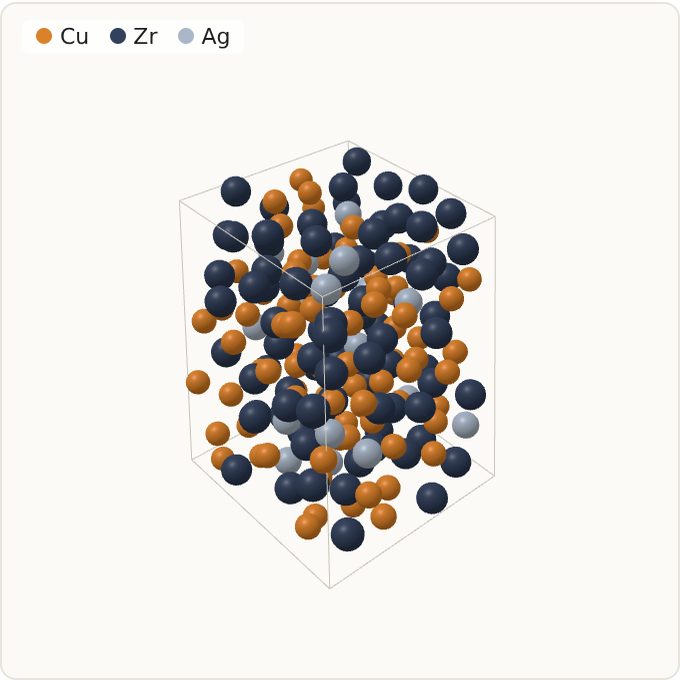
Cu–Zr is the canonical bulk metallic glass system, and Ag additions are reported experimentally to improve its glass-forming ability. This project uses classical molecular dynamics to examine which atomistic mechanism is responsible: whether Ag disrupts icosahedral short-range order, or segregates into a distinct Ag-rich amorphous phase. Holding Cu:Zr fixed at 1:1, it scans Ag content across x = 0, 5, 10, 15 and 20 at.% under a single melt–quench and deformation protocol, with at least three independent runs per composition and cross-validation between the Kang 2NN-MEAM and Sheng EAM potentials. Structural order, thermodynamic stability (Tg, Trg) and shear-band localisation under uniaxial loading are each analysed against the local Ag distribution.
ML-GLASS — Design and Discovery of Multicomponent Metallic Glasses with Machine-Learned Potentials
EuroHPC allocation on MareNostrum 5, Barcelona Supercomputing Center (BSC), etur126 · Principal Investigator · July 2026 – July 2027 (12 months)
Screening new glass compositions in silico sits between two methods with different limits: classical interatomic potentials are fast enough for broad composition scans but their accuracy depends on composition, while ab initio methods are accurate yet confined to a few hundred atoms and short timescales. This project develops machine-learned interatomic potentials with the aim of combining first-principles accuracy with classical-MD cost. The first phase builds an ab initio reference dataset spanning the liquid, supercooled and glassy states of Cu–Zr–Ag compositions — extended with Hf, Ni, Co and Fe where needed — and grows the training set through active-learning rounds. The second applies those potentials to high-throughput screening, running multicomponent candidates through large-scale melt–quench simulations and extracting glass-forming ability, glass transition temperature, elastic response and local structure for each.
Current Research Projects
Vitreloy 1 Revisited
The protocol developed for Cu–Zr–Ag is being applied to Vitreloy 1 (Zr41.2Ti13.8Cu12.5Ni10Be22.5), the alloy of the 2016 study above: ab initio melt–quench chains, structural and thermomechanical analysis, and cross-validation across independent potentials. A machine-learned interatomic potential for this composition is planned.
Cu–Zr Binary Glass Formation
Simulating the melt-quench process and analysing glass transition, mechanical deformation, and Voronoi structure in Cu50Zr50 binary metallic glasses using LAMMPS with EAM potentials.
Confined Electrons in Quantum Wells, Wires and Rings
This line of work uses an in-house finite-element code that solves the Schrödinger equation for electrons confined in semiconductor quantum wells, wires, rings and dots. It takes in electric and magnetic fields, intense laser light and donor impurities, alone or together, and from the resulting states computes optical properties: linear and nonlinear absorption, refractive-index changes, and second and third harmonic generation. The production code is written in Fortran, and an independent Python version reproduces its results. Before any new result, the code was tested against about thirty published studies.

Quantum rings under laser light. Intense laser light lowers the symmetry of a quantum ring, yet the ring’s Aharonov–Bohm transitions survive exactly, because a twofold rotation symmetry protects them. What the light can switch off is the size of the transition, and linear and circular polarization behave in opposite ways.
A terahertz switch. On the geometry of a real experimental ring, the polarization of a terahertz field turns the Aharonov–Bohm signal on or off with a contrast of about a hundred to one.
Coupled quantum wires. In two neighbouring GaAs wires, an electric field moves the electron from one wire to the other within a very narrow field window, and a single donor impurity shifts where that switch happens.
Resonant tunnelling diodes. The same Fortran code base also follows electrons through double-barrier GaAs/AlGaAs tunnelling diodes, solving the Schrödinger or Wigner equation together with the Poisson equation until they agree. Tested against 44 published studies, it places the current peak and valley within a few per cent, while the peak-to-valley ratio turns out to depend strongly on modelling choices that papers rarely state. It also shows that the loss of convergence past the current peak is a real fold in the current–voltage curve, which opens a bistable window of 15–20 mV.